Showing posts with label Spring. Show all posts

Saturday, October 13, 2018

Pumpkins!!

There are two types of people come fall....


Those who are thrilled over pumpkin everything and those who are rolling their eyes wondering why someone would ever ruin an Oreo or coffee with pumpkin spice.  Which are you?
Regardless of your take on pumpkin flavored and scented everything you can't deny that pumpkins are a staple decoration and food in the fall.  This isn't much of a surprise because it's the time of year when they come into harvest, and these orange fruits have some great stories and activities to go along with them.  I have complied a very small stack of pumpkin filled books for you to enjoy with your little ones of both fiction and non fiction.


The first book I have for you goes out to all of you that are in disgust over the pumpkin spice monopoly.
Too Many Pumpkins

written by Linda White
Illustrated by Megan Lloyd

When Rebecca Estelle was growing up her family could only afford pumpkins and that's what she ate each year.  She vowed that she'd never even look at a pumpkin again when she was older, and she didn't until one day.... and unforeseen event happens and her yard is full of pumpkins!  What is she to do with her unplanned pumpkin patch?
If you grew up on a low income or ever struggled you can relate to Rebecca and her distain of pumpkins. What I love is how Linda White turned this around into something good and beautiful at the end.  It's such a sweet story.
This is a wonderful book to have a conversation with your child about how you will use your pumpkins.  What would you do with a yard full of pumpkins?  What pumpkin food was made that you'd like to try?
The illustrations!  Oh I love cover, it's eye catching.  The look of shock on the lady's face and her cat while looking at a pumpkins all over just sets the tone for the book.  The colorful and animated illustrations continue throughout the book.  I love the facial expressions on Rebecca as each event unfolds.

 Now that we've read about having Too Many Pumpkins and what Rebecca did with her's let's explore how to grow a pumpkin and make a favorite tasty treat.
Grow a Pumpkin Pie!

written by Jane E. Gerver
Illustrated by Tammie Speer-Lyon

This cute book really is self describing in the title.  Jane goes over the steps for planting and growing a pumpkin, then to harvest it and turn it into a pie all while rhyming.  This simple level 1 reader from Scholastic helps those kids just learning to read on their own with short sentences and high frequency words.  This is a non fiction book that goes into how to plant and grow a pumpkin and then very simply it shares about fall and how to bake a pie.  I wish they actually did give the full recipe at the end of the book but more than likely everyone has their own family recipe.  Instead of a recipe at the end there are a few reflections aimed at young readers.  So you have a maze to do, match the pumpkins, sequence of events, and a rhyming activity that all match the words used in the book.  These activities are fun for the children and work to show comprehension and reinforce phonic skills.
This book would be a fun book to read in the spring before planting a garden and talk about what you want to grow and what steps need to be taken.  Then read it again this time of year for harvesting and making your treat.

Now that we know how pumpkins grow and what we can make with them...what about a story about a pumpkin that grew a little different than all the rest?
The Legend of Spookley the Square Pumpkin

written by Joe Troiano
Illustrated by Susan Banta

While this story is clearly a work of fiction the lesson in it is so dear.  Spookley is a square pumpkin (clearly that's stated in the title) but he's the only one and he doesn't like that he can't roll around like the other and doesn't like feeling different.  This is something a lot of kids and people can relate to.  Of course we are all different because we aren't robots and if we were the world would be so boring, but this is not how you picture things when you are young and are trying to fit in with everyone.
While Spookley is feeling like the odd pumpkin out a storm comes in and tosses all the round pumpkins all over and a couple break a hole in the fence and are lost to the bay.  Spookley sees that he can stop the others from the same fate and saves the day.  When the farmer discovers the one square pumpkin he saves Spookley's seeds and the next year grows all odd shaped pumpkins.
Fun fact you can incorporate with this book, while round is the natural shape of pumpkins and many other fruits and veggies but there is a company who has successfully made square watermelon!  Check out how and why they did.

Another book that teaches about how differences are good is:
The Bumpy Little Pumpkin

written by Margery Cuyler
Illustrated by Will Hillenbrand

 The Bumpy Little Pumpkin is about a family of Big Mama, two big older sisters and a little girl named Nell.  They grow their own pumpkin patch and when it's time to pick their pumpkins to carve each older sister picks out a big pumpkin.  Only Nell finds a small little pumpkin that's bumpy that she likes.  The sisters tell her to pick a smooth one but Nell decides to keep her own and ends up with a cute Jack O'Lantern.
I find it neat how Margery included animals in this story.  There's a reindeer, a bear, hare, crow, Cardinal, and Sparrow who all help Nell in carving her pumpkin and felling better about the pumpkin she chose.  This book offers a couple great lessons you can expand upon.  If you have a little zoologist on your hands you can dive into each type of animal listed and learn more about them.  Study what type of birds you have in your back yard this time of year.  Also you can compare how each pumpkin is different and how it's okay to have one that is so odd looking because you can make something unique out of it.  There's also the obvious "now let's make our own Jack O' Lantern."


Speaking of Jack O'Lantern's where did that tradition come from?  Read this folklore book that started this tradition and be sure to check out the link above to see what History.com had to add to this legend.
The Story of the Jack O'Lantern

written by Katherine Tegen
Illustrated by Brandon Dorman

This bit of folklore that is retold comes from Ireland and is hundred's of years old.  There once was a mean old man named Jack who made a deal with a Devil and when it was his time to pay the Devil back he caught the coal thrown at him in a carved pumpkin and was cursed to wander the earth.  In short that is the story.
I hadn't heard this before so I found it interesting and of course Katherine Tegen goes much more in detail and has a fun animated story to read aloud.
The dark illustrations done by Brandon Dorman really capture the rotten spirit of Stingy Jack.  Even the daytime images are in non vibrant colors so there's a feel of foreboding and a different time period.  The illustrations I really love in the book are the ones at night.  I love how he captured the crisp fall night sky, with scattered clouds, and the shadows and how the moonlight reflects off the pumpkins.  The feeling of a late October night is perfect and beautiful to look at.
Fun fact learned in the author's note: the original jack-o-lanterns were carved out of potatoes, beets, and turnips.  Would you try your hand at carving something as small as a beet?

I love looking at carved pumpkins, and it's on my bucket list to go to a pumpkin house where there are hundreds of carved pumpkins to view.  I would love to do that!  Want to try to up your carving game?
Extreme Pumpkins 2Take Back Halloween and Freak Out a Few More Neighbors

by Tom Nardone

I'm going to highly recommend this book for those kids who are crafty and into Halloween.  I love Tom's added comments like his taste comparison of different pumpkins for cooking.  (Did you know there are different types of pumpkins?)  This book reads like a cook book with notes from your mom's funny best friend!  You are gives a list of items (ingredients) you will need and shown a picture of what you can potentially make, and then you are given some directions and set on your own to see what you can create.  Please use this book with adult supervision!
Need some carving tools?
One last book I want to leave you with is a nonfiction from National Geographic Kids all about...
Halloween

by Laura Marsh

As a general rule of thumb, you can't go wrong with National Geographic especially the ones aimed for children!  I have several of their books and we read them often.
I find that this book is a bit different than the NatGeo animal books we read in that it has many open ended questions throughout it.  These questions are great because it's engaging in conversation.  Another thing that is different in this book from most others is that it has jokes.  Yes, they are corny kids jokes that you use to read on go-gurts or Popsicle sticks, but they are still funny and kids love them!
After the first couple pages you get into the fun facts and more in depth information that you would expect to find like how pumpkins grow (did you know each pumpkin has about 500 seeds in it?!) and gives you some ideas on ways to decorate your house.  There's a page the mentions the traditions of Halloween and another one for The Day of the Dead.
Overall this book is great for young children because they love having the chance to talk and getting to respond to questions in a book.  After first grade I think they might be looking for more of a story or more information.  Compared to other National Geographic books I have this one didn't quite meet my expectations but it's still a fun and easy read for younger children.


Since I only touched the tip of the pumpkin pile of books if you are still looking for some other ones check out these two other blogs:

Hope you enjoy these books and if you have a favorite pumpkin themed book I didn't list please comment it below so I can check it out!!

Thursday, September 27, 2018

The Seeds of Fall

Welcome Fall!
While many people think of the trees and leaves as dying right now, is death the right word to use to describe what is happening?  It's actually not. (Check out what I learned about this in Full of Fall on my last blog post.) Sure the leaves themselves die, but the tree doesn't.  And there's more than just the lose of leaves that's going on this time of year.  Think of all the seeds we see this time of year and what is happening to them. I love when I pick up a children's book and learn something new and I have two books that focus on seeds to share with you today.

Because of an Acorn
Written by Lola M Schaefer and Adam Schaefer
Illustrated by Frann Preston-Gannon

Along with leaves falling everywhere this time of year, there are acorns everywhere. I love listening to them fall down through the trees, and watching the chipmunks and squirrels scurry about gathering them.  I think that's one fall activity that is often overlooked so I love how this book brings this activity to mind.

Because of an Acorn is a fantastic, simple book about the circle of life.  I love that you can see and get a sense of the circle of life without it being too emotionally overwhelming for children.  I think the authors did a beautiful job of showing how each part of a forest ecosystem is connected.  That acorn grows into a tree, the tree houses all sorts of wildlife, and because of each one something else comes to live and grow.  Fran Preston-Gannon has done a wonderful job detailing each part that is  highlighted in the text and foreshadowing what will happen next.  The illustrations are full of color and dominate the pages.  I love how Fran has made sure to include so many other animals and parts of the forest that aren't in the text, you see a bear and cub they they aren't mentioned, but this shows so much more of the ecosystem and brings up more for conversation.

 The sequence of event is flawless! The lessons you can make off of this one simply written book are countless.  The dedication says, "For all the naturalists, young and old -L.M.S and A.S." and they are right, it's a book that as an adult I find beautiful but it's written on a level for children to understand.  Looking at this book as a teacher I can see lessons for preschoolers all the way up through biology class being tied into this book.

Lesson ideas from this book:
Who lives in a tree?  Who lives in the forest?
Circle of life.
What is an ecosystem?  Take it farther with notes from the afterword in Because of an Acorn and examine how that would effect the environment if one part of the system was changed (died off).
Do some Acorn Crafts for adults or kids (Thank you Pinterest!)

Some additional learning games for children:
Collect acorns or use some fake or wooden ones for counting, sorting, or markers for fall bingo


I know I have shared the Sneaky Snacky Squirrel game before, but our preschoolers really love this game and it goes so well with this book I have to share it again.  And check out the Acorn Soup game I found for children age 2:


A Seed Is Sleepy


Written by Dianna Hutts Aston
Illustrated by Sylvia Long

The very first thing to take me in with this book is the astounding detail in the illustrations!  Sylvia Long has done a fantastic job showing each seed, plant, the flowers, fruit, and leaves.  The colors are bold and brilliant and draw the reader in.

This book came highly recommended to me from a librarian who knows how much I love being outside and nature.  This is a book I get wrapped up in just studying it.  Each flower, and seed are labeled and the amount of information packed into this kids book really is amazing and makes it a book that any adult can pick up read and learn something new from.  We had lessons in science about the stages of seed growth in school, but I didn't learn the different parts of a seed.

Dianna has made a very diverse, non fictional book about seeds that's completely captivating.  I say diverse because there are (in my opinion) three different ways you can read it.  There is the main sentence "A seed is sleepy...A seed is..."  so if you have a group or a child with a shorter attention span you can just read it that way the build up to reading more in depth.  For my five year old daughter I read her the main sentence and the bold part that starts to explain what they mean by sleepy or thirsty.  Then there are longer paragraphs that go much farther in depth to talk about a certain seed which is really neat.

This is one book that isn't focused on fall.  It's a book you can read in the fall because many plants go to seed in the fall like the acorns falling or another way to look at it is that the seeds have grown and their fruit is ready or the seeds are ready to harvest.  This book would also be great to break out in the Spring  and read about seeds then and do your own grow kit.

No matter the season, I hope you take the time to look over both of these wonderful books and notice the small details in life.


Friday, June 1, 2018

Farmer Brown Shears His Sheep

If you want to take your children on a journey about fleece from sheep to yarn for a sweater then this book is PERFECT!  Or if you are just looking for a fun book to read I recommend this one.

The Details:

Farmer Brown Shears His Sheep: A Yarn About Wool
Written by: Teri Sloat
Illustrated by: Nadine Bernard Westcott
Copyright: 2000

Teri Sloat has put together a fun, comical, fast pace adventure that tells of the process of where wool comes from, how it becomes yarn, and how it is used.  The book follows the sheep as they get sheared, and all their fleece is removed. They become cold and follow their wool on it's journey with the farmer from shop to shop in it's process of cleaning, combing, spinning, dying, and finally being knit into sweaters.  Sloat has delivered all this information in a short rhyming story that flows so easily from one page to the next.  At the end of each short stance you are eager to turn the page to find out what is happening next.

One of the things I like most about the book, aside from the lesson on wool, is that it breaks down sexist barriers and shows that we need to eliminate labels on jobs, hobbies, and likes.  Typically many people associate knitting with old ladies "my grandma knits." Why?  I love that the farmer (male) is the one who knits, who enjoys knitting.  I recently saw a short video of a young man that started his own knitting business and another one where men share how they were introduced to knitting and how they enjoy it.  If this book inspires you to try knitting here are a couple kits for beginners along with a video to help you out.
For children:
For Adults :
The main focus throughout the book are the sheep and the process of the fleece going from them to all the shops.  I love how much you learn about wool.  This book would be great to read before going to see sheep in person, or a place like Quiet Valley where children can actually feel fleece, and comb the it, and see how much work goes into the process.  You might be able to reach out to see if there are any local sheep farms in your area and see if they will give you a tour!

I love when you can take a book that is well written and fun, and then can go and do something from the book and be hands on, I think that balance completes the learning cycle and graphs all that the children have learned into their memory.  Unfortunately I have not done either of the hands on lessons with my children (yet!) but I plan to try knitting with my oldest this fall/winter.

Nadine Bernard Westcott did the illustration in watercolor.  (hint you can find that info in the credits on the same page with the copyright and publication information.  Take a minute to show your children what they can learn on that page)  The illustrations are vibrant, and full of funny sheep and characters that we met along the journey.  With the help of these wonderful images the child doesn't need you to look up what shearing is, how wool is combed, and what knitting is.  Westcott did a beautiful job telling the story through her art.

I hope you take the time to check this book out, maybe even try a new craft.
 

Thursday, May 24, 2018

Nana Hannah's Piano: baseball and piano aren't the only lessons in this book

I won Nana Hannah's Piano in a raffle basket and loved the title.  Then in looking at the book and reading the "Dear Parents" note I really wasn't sure my girls and I would like the story line.  I'm happy to say that the book was a success in my home.

The Details:


Written by Barbara Bottner
Illustrations by Diana Cain Bluthenthal
Copyright 1996

This story is about a boy who loves baseball.  He has to take piano lessons, but all he really wants to do is play ball!  When his grandma gets injured he spends a week with her.  She loves tango, and has a piano she enjoys playing.  While he's with his grandma he gets her interested in baseball (it's not as good as tango) and she plays a little on the piano.  He wants to do something that will cheer grandma up and slowly comes up with playing her a song on the piano.  Only after he finally finds a song that he loved does he realize that he can like and do more than one thing.

The story is cute and if you have a boy in your house who loves baseball but you want him to do something else as well, then this book fits that small niche.   Don't give up on this cute story if your child doesn't fall into that niche.  I have two girls, neither of which play a sport, an instrument, or take dance lessons so my children' don't have anything relateable to the book at all, or so I thought.

Turns out after reading it they really enjoyed the story, and have asked for it to be read to them a few times now.  So why is this book one they like?

Each page has only one to two good sentences on it.  This makes them fast paced, easy to follow and great for those who are having a hard time with reading or a read together book for those learning how to read.

The illustrations are full or color and life!  The facial details are what I'm drawn to, the scowl on the piano instructor's face, the tongue sticking out in constration on the boy, the smirk of amusment on the grandmas face.  These details are what make it great for me because you can ask what they are feeling or what are they thinking about.

Beyond just the sentence structure and illustrations there are a couple universal lessons that each person can connect with:

  1.  to learn someone, and enjoy it one must have a good teacher.
  2.  children want to help others.
  3. .we are not limited to only doing one thing.
  4.  don't give up on yourself


These lessons, that we can all connect with, I think are the reason why children who don't fit into the small niche that I think this book was written for, love this book.  Think about them each this way:

1.   A teacher who knows everything, yet has no compassion for the person they are teaching will not break through.  A teacher needs compassion, understanding, and fluid ways to connect with who they are teaching.  The piano teacher may have been very predominant in her field but the child was only scowled at, intimidated, and heard that he was hopeless.  Oh how terrible.  One teacher like that will ruin a subject for a child.  Kids absorb what they hear and see all the time and believe that.  I wouldn't want to play piano with that teacher either!

2.  The boy went over to the grandmothers and wanted to help her.  He showed her what he loved, but when that still didn't cheer her up he tried playing the piano knowing she enjoys that.  Kids while they do things they know we won't like, they are only doing that for attention.  Notice a child the next time someone in the house is injured or sick.  They will try their hardest to make that person happy and to be helpful.  Last week I lost my voice, it was awful, but my oldest did everything she could to be a help.  She read to her sister (now this is my daughter who struggles with reading and really doesn't like to) she read to me, she made me a card, and she could be heard saying "you know mommy can't talk so we have to be really good" to her little sister.

3.  There is nothing that says we need to limit the things we want to accomplish.  I remember reading a great children's book that went into this,  When I Grow Up that I will have to write up a review on.  We are not limited in our skill, unless we set (or don't believe in) them ourselves.  Why can't a boy be great at the piano and baseball?  Why can't a girl be a wonderful dancer and musician?  Why can't you be a coder, runner, and singer?  Always be open to trying new things!

4.  I really didn't like when the mother said "We don't have quitter in this family" because I don't think children should be forced to do something they don't want.  Why keep spending money on dance lessons when your child cries and fights you about putting on the tap shoes?  At the same time tho, if it's only because it's hard and not because it's not something they don't like then yeah you have to stick with it.  The message of practice, and perseverance is clear in the story.  The boy practices and keeps playing one song until he gets it.  Hard work pays off.

Now that I've shared about the subtle lessons in the book let's go over some activities you can do with this book either in your home, classroom, or story time.  The way the book is structured it does make it easy to read aloud to a group of children.

You can have a whole lesson on baseball from the book, what each position is, terms, and how to play.  You can use the vocab from the book to make a display, or set up and play a game of ball.

Have them write about what their grandmas like to do and are good at.  It would make a great grandparent's day book.  What activity would they give up to do something with their grandma? Use open ended questions about grandma for journal prompts for older children.


Then there's the obvious music lessons you can connect with the book. Play the song "Take Me Out to the Ball Game" what are the lyrics, learn to sing it.  What does sheet music look like?  How do you read that?  How do you play the piano?  Use apps or books or get a lesson or take a class on the piano.  What songs are played for tango?  What is tango?  Learn to dance the tango!

I hope this book has inspired you to look beyond the first impression of a book and to find deeper meanings and lessons you can take from books you read.  May your children have many passions and skills that they explore.

I hope you enjoy the activities I listed above, I'm sure there are more you can do with this lovely book, comment below something you love about the book or an activity you did.

Thursday, May 17, 2018

Rainbow Books

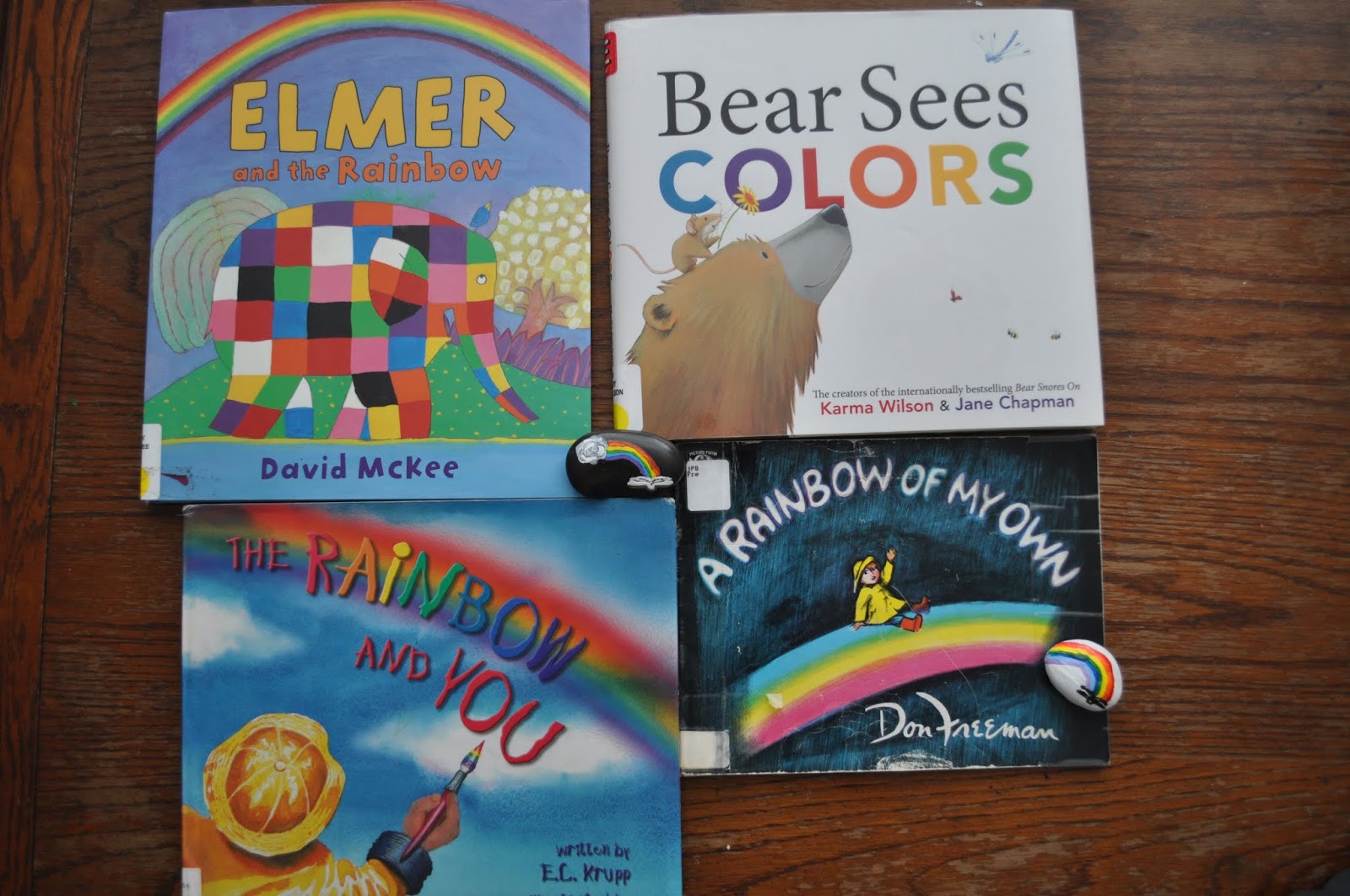
Who doesn't get super excited when they see a rainbow? Kids jump out of their seat, and everyone just takes a minute to admire this art in the sky.  Why not turn your living room, or classroom into a rainbow for an afternoon?  These books, crafts, songs, and activities can help you and your early learners discover all about the colors of the rainbow, plus how to spot one, and enjoy a couple fictional stories that include rainbows.


I'm going to start with what's probably my favorite (so far) non fiction book that has a rainbow in it:

A Rainbow of My Own by Don Freeman

Copyright 1966

This book is from 1966 but it's timeless.  I think every child can relate to the main character. The boy runs outside to try to capture the rainbow just to find it was gone, then as he's wishing for one of his very own, what should come up behind him but a rainbow ready to play! Then when it's time the rainbow leaves and he goes home to find in his room a rainbow on his wall!

This book keeps the sentences simple so it's great for reading to a group, to small children and on their own for independent reading.  The illustrations are fun, colorful, and entertaining. The yellow rain boot, hat and raincoat are classic.

Don Freeman was a creative mind and opens a doorway between reality to imagination back to reality seamlessly.  This doorway in the book, we can pull from it so many opportunities with our own children:
Where and When do you find a rainbow?
If you had a rainbow for your own what would you do together? (This can be used for all ages: Draw a picture. Tell a story. Write a paragraph of what you'd do together.)
Where would a rainbow hide?
How can you make a rainbow of your own?

These are all questions for fiction and non-fiction learning!  I love this book.  This one book out of all you can do a whole rainbow lesson on.  So if you had to pick only one A Rainbow of My Own would be the one, but to enhance your story-time, or lesson add a couple of the other books I have listed here.

Elmer and the Rainbow by David McKee

Elmer has many books (Elmer 12 Book Set Here ) and if your child already knows this patchwork elephant than this is a book to add to your rainbow lesson.  It is another fiction book.

In this adventure Elmer and his friends notice an odd thing in the sky, a colorless rainbow, so Elmer goes off to find the end of the rainbow.  Along the way he asks his jungle friends to help him in his search.  Once the rainbow end is found Elmer goes and gives the rainbow his own colors.

What I love more than anything in this book is this quote:
"Some things you can give and give and not lose any.  Things like happiness or love...."
Brilliant quote about how kindness is free.  Be Kind! 

We all know that there isn't a patchwork elephant, and that's not how rainbows get their colors, but it is a fun imaginative story that can lead to the question of "Well how do rainbows get their color?" (So glad you asked because I have a book to share with you about just that!!)
Elmer has colors on him that aren't in the rainbow.  Point that out!  What colors are on Elmer that aren't in the rainbow?  What colors are in the rainbow?  This would be a great time to share the song In The Rainbow by Pamela Piersyn.  I love this catchy song that isn't annoying, and is educational!  Good bye ROY-G-BIV. Hello "In the Rainbow" Promise you if you play this song the kids will know all 7 colors of the rainbow!  While I sang and listen to this song with the children I assembled a felt board rainbow.  If you want the children to have a fun rainbow toy so they can use all sight, touch, along with hearing check out this stack-able rainbow toy!  It has all 7 colors so they can build their rainbow with the song as well!!


 Two other books that I used for my All the Colors of the Rainbow lesson were Penguins Love Colors by Sarah Aspinall and Bear Sees Colors by Karma Wilson

Both of these books are great for helping children learn their colors.  Penguins Love Colors has rainbows throughout the book and each little penguin has their own color, but the downside to this is that there are only 6 penguins instead of 7.  This is quite common in many early learner rainbow books, they don't mention indigo so when the children are older and they are thrown for a surprise that there are really 7 colors.  Don't let this keep your from using this great story because you can ask them what color is missing?

Bear Loves Colors does not have a rainbow anywhere in the whole book!  So why did I put it in my story time?  Simple, it's a FUN book to read aloud with the children.  The rhymes allows you to let the kids yell out what color Bear is going to see next.  It's reinforcing their colors, and allows them to search each page for things of that color.  Bear sees Blue!  Blue berries...and then you can ask "What do you see that's blue?  You can make a scavenger hunt game out of the book for kids to do next time they are outside to see if they can find each thing bear sees, or something in nature of each color.

In my story times after reading these books that reinforce the color names I did a simple song again using all the colors of the rainbow.  I made little finger puppets for each color out of felt and sang:
"Red color. Red Color, Where are you?" and hold up the red puppet "Here I am. Here I am."  I'll admit it came from this video that my daughter watches.
And after you've gone through all seven colors do "rainbow" or "all the colors" for the last verse.


Now that the children know the colors in the rainbow let's go back and answer that question of "how do rainbows get their color?"  The one non fiction book I used was The Rainbow and You by E.C. Krupp

The Rainbow and You is written for an older audience Amazon suggest 6-12 year old. When I used it I had mostly 5-7 age range in my group and so I didn't read it cover to cover but marked a couple pages and read only a few passages to the group.  I love that E.C. Krupp teaches children how to find a rainbow.  He also shares different legends of Rainbows from Native Americans to Greek Gods.  There's also the science and discovery of rainbows in the book.  It's packed full of information.
Robin Rector Krupp illustrated the book and I love how she portrayed Roy. G. Biv as a person! That image will stay will me now every time I think of ROYGBIV.

Since doing my story time I have found other non fiction books about the rainbow that I need to check out and see if any of those will be better suited for the younger children I typically read to. (I've shared them below)  If you are interested or have read these title please let me know what you thought of them in the comments.


 Craft time!  There are countless rainbow crafts out there!  These are the crafts I've done with my kids both very similar :

1
2
1. Construction Paper assemble a rainbow from cloud to pot if you want to do this for St.Patty's day cut out some gold chips to add to it.

2. We did this one at my daughter's preschool:
*cut a paper plate in half***to  implement the reduce and reuse from environment mindfulness post instead of wasting paper plates reuse some old cereal boxes and cut out a cloud shape
* Tissue Paper Streamer
*cotton balls to make the cloud puffy (or puffy paint)
Assemble the rainbow with the materials

3. For older children you can do some painted rocks:
* smooth rocks, paint, paint markers, and seal.  You can use rocks from your garden, or the dollar store as well as the ones I've shared here.  Before you use the rocks wash and let them dry.  If you use dollar store rocks boil them to remove the wax on them.  The paint and paint pens that I've shared below are amazing! But feel free to experiment and find what works best for you.

I hope you have a wonderful colorful day today and maybe you will even find a rainbow of your own!

Monday, March 26, 2018

Easter Books for Children

Easter is this weekend!  If you're children are like mine you've probably been reading Easter books, coloring eggs, doing crafts with plastic eggs, preparing Easter baskets, and going to local egg hunts.  Busy, busy! I wanted to share some of the books we love, and a couple craft ideas.


My childhood Easter book:  The Story of the Easter Bunnyby Katie Campbell
Published 1993 by Unicorn Publishing House

This was a book I got for Easter when I was in pre-school.  Somehow it has been very well taken care of and I now read it each year to my own children.   I love this book.  It does start off with a lot of words and might not keep young children's attention like shorter books, but it does have a nice pose to it to be read aloud.

Katie Campbell tell a story of the Easter bunny who use to be very small, as he grew he was picked on and went through struggles, until one day a child found him very weak and nursed him.  When he was better he wanted to thank the child so he made a basket, and painted eggs and left them for her, and he returned to his home where the other bunnies picked on him and he was a beautiful grown bunny.  The Story of the Easter Bunny is like and Easter version of The Ugly Duckling.
While the story is sad, the bunny runs away from home and has a hard time, it does end sweet with him growing into a beautiful bunny that gives gifts.

My favorite part of the book are the beautiful full page illustrations done by Mary Hildebrandt.  The illustrations are full of color and completely pull children into the story.  I love how the text isn't superimposed over the illustrations.  These attention grabbing illustrations are full of emotion, and tell the story all on their own, which with early readers is so important that they can look at the image and tell the story on their own before knowing how to read.  The emotions in the art also help children identify how the bunny is feeling, and can teach empathy.  "Look at the bunny here.  How do you think he feels?  How would you feel?  What could make him feel better?  What do you think of this?"

Craft Idea:  Aside from painting eggs with your kids have them paint kindness rocks and hide them to brighten someone's day.

I love painting rocks with my children, you can add words of inspiration or a message of kindness to them as well for others to find.

If you're having trouble coming up with some egg stuffing ideas you can add rocks to plastic eggs as well painting some for your children to keep or leave them unpainted for your little artist to paint.

I know for years The Tale of Peter Rabbit by Beatrix Potter use to be a popular books for Easter, it's what many of us grew up reading and hearing around this time of year.  The story of Peter Rabbit tho isn't about Easter, or eggs.  The book is great for any time of the year.  We all know this book, Peter is a naughty rabbit who goes into Mr. McGregor's garden after his mama told him not to, and he find himself in some danger of the farmer, and the cat, and getting lost.  He of course gets home safe and his mom takes care of him, and puts him to bed while his siblings have a nice supper.

Grace Maccarone has taken The Tale of Peter Rabbit and continued it into an Easter story in her book Peter Rabbit's Happy Easter.
Published 2006 by Scholastic

I love how this book picks up right where the Tale of Peter Rabbit leaves off, it starts with Peter waking up the next morning feeling bad for not listening to his mama.  This makes the book both able to be read on it's own or part of a story time where it can follow the original story Beatrix Potter wrote.

The story is fun and engaging, while the writing is simple to keep the attention of young readers.  The story is super cute with how the eggs were collected, an accident paints them, then how they were hidden.  I love that this story comes out and says "you should not take what isn't yours."  This lesson is very important for children.

The illustrations in this more recent story stay very close to those we grew up with in the original story.  This is because David McPhail did the illustrations for both books.  They are colorful, and detailed and tell the story.  They engage the children and keep their attention.  I love that in the second book there is more humor in the illustrations and made the children (my children) laugh and talk about what was happening.


Craft Idea:  To go along with using eggs collected from chicken, save your egg shells (wash them out) and fill them with paint and use the eggs to paint with.  A couple years ago I tried it out with my children.  The Easter bunny left paint and canvas for each girl and I saved egg shells and they had fun throwing the eggs full of paint at the canvas.


My youngest has always love Lift-the-Flap books and she has come across two books that she loves and we have read over and over:

Dora's Rainbow Egg Hunt
I love books that have children's favorite TV show character's in them.  I think they draw young children to them and make them want to read their book.  Dora has long been a favorite in our house.
Dora's Rainbow Egg Hunt goes through the colors of the rainbow (leaving out indigo) as they collect Easter Eggs of each color. As with all Dora books children get an introduction to Spanish.  Each flap they lift has something of the color under it "A yellow snake. Una culebra amarilla." The child keeps lifting flaps until they find the hidden egg "The blue egg. El huevo azul." The sturdy board book pages are great for wear and tear, and this book is shorter than most of the Dora stories we have read which is nice for children who have short attention spans.  The only down side to this book besides not including all seven color of the rainbow is that many of the flaps are tiny so the text on those tiny flaps is even smaller!

Craft Idea: To go off the colors they children learn with Dora take plastic eggs and have the child name the color and help you glue them together and make a Easter Egg door wreath.

If you don't have plastic eggs or want to do something different you can also cut out egg shapes and have the child color them in and glue them together to form a wreath.


The Easter Bunny left us what is my favorite lift-the-flap Easter book two or three years ago:
  Peter Cottontail's Easter Surprise
Written by: Joseph R. Ritchie
Illustrated by: Lydia Halverson
Published by CandyCane Press copywrite 2006

This is another sturdy board book and unlike Dora the flaps you lift up are large and thicker.  These differences has made the book I found at a thrift store last the past two or three years with much use and still is in great shape.

In this Easter Surprise book we are finding what Peter has left for each animal, so it's a different take than the other books I've listed here. 

As we meet each animal, we are told about them and get to guess what is in their egg.  The short pose is easy to read and rhymes. I love that there are new words introduced.  Instead of keeping the wording super simple like many board books do there are more colorful words to increase vocabulary.  "Happy Jack is on the prowl," not just hunting.  Each page reads like a fun adventure poem.  I've read this book at least 7 times this past week and it's still fun to read out loud.  I also want to mention how creative the gifts are that are inside the eggs.  Coconut covered cheese balls for the mouse.

Lydia Halverson has done a great job with the illustrations, so the child's attention stays on the page and helps them follow along with the story.  The little image of Peter Cottontail looking out of the text box to spy on the animal finding his gift is a cute touch.  Colorful and engaging. This book is one your little one will love for years to come.


I hope you all have a very HAPPY EASTER!


Saturday, February 24, 2018

A Springtime story "Lost in the Woods"

Spring isn't too far away. With the thought of melting snow and how soon we will see the grass turn bright green, the trees start to bud, and flowers making their appearance, I have been in the mood for some good springtime books!  I came across this one that the title caught me first Lost in the Woods What's it about? Does a kid get lost in the woods? Does it tell you what to do if you get lost? As all these questions about the title rolled through my head I knew I had to read it regardless of what it was about.  Picking it up I found that it's a Photographic Fantasy, with a fawn on the cover.  I was sold, this was the springtime book I wanted.

The Details:


 by Carl R. Sams II and Jean Stoick 
Published by Carl R. Sams II Photography, Inc.
Copywirte: 2004
Grade level: K-2
National and International Awards for Lost in the Woods:
2006-2007 Children's Crown Gallery Award Nominee
2005 Independent Publishers Best Children's Picture Book Award
2005 Earlychildhood NEWS Director's Choice Award
2005 Earlychildhood NEWS Judge's Choice Award for Excellence
2005 USA Book News Best Children's Picture Book Award
2005 Library of Michigan "Michigan Reads!" Finalist
2004 Great Lakes Booksellers Association Book of the Year Finalist
2004 ForeWord Magazine Book of the Year Finalist


That is an impressive list of awards for any book, and it's easy to see why it received so many awards.  The photography is stunning and interactive.  The story goes perfectly with the subjects in the photographs, it's educational, and the story is fun to read aloud.
I will say I agree with the Kindergarten and older reading level.  My four year old and the other preschoolers I tried to read this book to were not interested.  They liked to look at the pictures but they lost interest quick in the story.

The story is about a fawn waking up in the woods alone, the other animals think he's lost, but he knows his mom will come back.  The fawn walks around the woods alone and meets other baby animals.  Finally at the end it's his time to join his mom and wander around.

Carl and Jean did a great job with putting a fictional narritive to the photographs they took and incorporating some nonfiction in as well.  Children learn about some different animals in the forest, what they do, and about the first two weeks of a fawn's life.

These two wild life photographers tell how they wrote this book to educate people that when they see a fawn alone in the woods they aren't abandoned, they spend most of the first two weeks of their life alone because the mother's sent will attract predators.  (This and more about the authors can be found on the inside back jacket cover of the book)   If you come across a baby deer laying in the grass alone you should leave it be, you can keep an eye on it, if you notice that it is injured, week, extremely thin or you want more info about finding fawns in the woods you can check out the National Wildlife Federation.  If you want to have a check list of questions to ask yourself you can find a detailed list here by Second Chance Wildlife Center.

There are many lessons parents, and teachers can use from this book.  I'd highly recommend it for anyone wanting to do a spring, baby animal, or nature lesson, identify animals, their sounds, where you find them, what they do, and so on.

I thought the book was easy to read. I'd say it's at a 1-3 grade could read most of it on their own with little help.  Reading it aloud I believe is the most fun and useful though so you can animate the sounds of the animals.  Example:
"Look how he used his spots.
He did. He did," said the Katydid
Then there's the little owl that was also another favorite of mine:
"Who-hoo-hoo do I see?"
hooted the little saw-whet owl.
"Someone's moving through my woods.
I saw-whet!
I saw-whet!"

There is a special treat at the end of the book, there's a page of did you spot these animals? And we spent time looking back through the book to find a little bunny, a caterpillar, and still haven't found the Tiger Swallowtail butterfly.  This was a lot of fun to do a look and find through each of the pages.  My youngest even noticed a shadow on the page about predators which I had read and searched twice before she pointed it out to me.  I think it's a great book you can read and find something new in with each read.

What did my daughters think of it?  My youngest lost interest in the book right from the start the first time we read the book for their review so only my oldest shared her thoughts on Lost in the Woods, you can view her video review here.  It wasn't until bedtime that my youngest would look through the book with me, and it's not one she will pick out to read together.

The Bottom Line: Perfect Spring Read
The story-line: is fun, easy to read, educational, and entertaining
The art: is colorful, extremely interactive, educational, and aids the story.


The Biggest Love of All

Love. There are candy hearts  and teddy bears, cards and books  filling the shelves. TV commercials  and billboard signs, all...