Showing posts with label inspire your imagination. Show all posts

Tuesday, January 22, 2019

The Gingerbread Man Loose in the School with discussion questions and activities

I had a lot of fun with The Gingerbread Man Loose in the School by Laura Murray.  I used this book for a children's book club book, and found so much that could be talked about and activities that could be done around this adventurous story.

First let me tell you about the book.

I learned that this was Mrs. Murray's first book!  She had been a teacher and this book was an activity she had done with her class at the beginning of each school year!  This is a great book that you can use on the first day of school to start off the year or read it and have fun at any point in the year.

In the book a class bakes a gingerbread man and then they leave for recess, the gingerbread man then explores the school trying to find his class.  He meets the gym teacher, nurse, art teacher and the principle.  I love how the book is an introduction to school and different rooms of the school, and a twist on the original gingerbread man story.  When I presented this book to preschoolers I retold the original story first with puppets, that way they can make guesses about what they think will happen in the book and compare the two stories.

Puppets I made for retelling the original story (condensed) 
Laura does a great job in rhyming and using some great vocabulary words in the rhymes.  I don't think I would have thought to rhyme with "complete" or "explore."  I thought this was very clever and Murray does add in many great vocab words to share and discuss.

The lay out of the book is another point worth sharing.  Unlike most picture books that have one photo per page or page spread, Mike Lowery has done the illustrations for The Gingerbread Man Loose in the School in a comic book style, where there are a typically two to four boxes with illustrations on each page.  I like this layout.  I love that each page isn't in the same format, some pages have three illustrations, some have only one and the timing of each set lets you ask your readers to predict what they think will happen next.

My favorite thing about this book is all the opportunity there is to have open ended discussion with your readers.  There are also many crafts and activities you can do around this book and gingerbread men in general.  Let me dive into sharing some discussion questions I used while reading this book.

Pre-Reading...Before you even open the book here are some questions to get the mind working and predicting:

What do you think will happen in this book?  This is a question that you can ask before reading any book.  Look at the cover, what clues does it give you for what this book is about?  What does the title say about what might happen or who might be in this book?  

Who is the author?  Illustrator?  This allows you to teach the kids what an author does and what the illustrator's job is.

Where do you think a gingerbread man would have the most fun at school?  I loved asking this question and listening to the different responses.  Don't be afraid to ask the kids Why they chose the room they did.  My oldest daughter answered with, "A gingerbread man would have the most fun in the gym and art room. Because they are my favorite places. He'd make a mess and play with the stuff and create portraits and paper-mache" While my youngest chose the playground because he'd have fun playing there.  Let you're child's imagination run wild here.  For teachers you can turn this into a writing assignment for older kids.  Not only where would he have the most fun but describe what the gingerbread man would do.

While Reading Questions:  As I said earlier the layout of the book offers many areas not only areas to ask "What will happen next" questions but many chances for other discussion as well. These questions you can choose some to ask during the reading of the book or save other to ask when you've finished reading and go back to the page you're referring to if you want.

What other ingredients might you need to make gingerbread cookies?     What would you use to decorate a gingerbread man?

The Gingerbread Man broke his toe!  Have you ever broken a bone?  Where can he go to get his toe fixed?  Who could help him?  How will the nurse fix his toe?

Is using the handrail as a slide safe?  What could happen to the gingerbread man by sliding down the handrail?  In my online group I asked the adults to admit to having done this, I never had the guts to and when I read the book to preschoolers I remind them that it's not safe and if Miss Fawn were to try it I'd probably fall and get hurt, but since this is a cookie and he's in a book he can try it and anything can happen.

When he lands in the lunch bag you can ask Do you like cookies with your lunch?  What is your favorite type of cookie?

Post-Reading-Questions: 

Which gingerbread man story did you like better, the original where the fox eats the gingerbread man, or the school one where he becomes part of the class?

What would you do if your gingerbread man came to life?  This was a favorite question of mine to ask because it's completely open ended with no wrong answer.  Asking this in a group setting was interesting to see how many different answers there were.


How would you feel if your gingerbread man ran away?


What was your favorite part of the book?  Why?

What did you think of the illustrations?  This is a good question to ask for any book because you're showing them that they can have their own artist style.

Would you recommend this book to other people?  Why or Why not?

There are a lot of directions in the book, are you good with finding your way around new places?

For comprehension:

Who did the gingerbread man meet?

What happened in the book?  Go over the sequence of events.


Activities!!  

Be your own illustrator!  Create your own gingerbread man.  As the adult you can decide what materials you want used or let your kids decide how they want to make their gingerbread man.


Baking!  Obviously the book opens with cooking and is a clear activity to go along with the book.  Break out the aprons, dust off that gingerbread cookie recipe and create your own man or girl.  You don't have to stick with gingerbread, have your kids help bake their favorite cookie.

Rhyme Time!  The book is full of rhyming words.  I took a poster-board and wrote down several different rhyming sequence that were in the book then had kids match up the rhyming words.  You could ask further this by having them write their own rhyming word to go on the board or list.

Two different games I designed were for preschool and kindergarten and you can customize this to fit your own grade level.  I did numbers for preschool and had kids take turns rolling a die and coloring in the number they rolled.  They had to count the number of dots on the die and find the corresponding number on their picture and color that in.  In small groups they took turns and helped each other.  For kindergarten I used sight words and flash cards.  You can draw up your own outline and do multiplication, addition, or whatever you want to practice with your kids.  If you want some that are already done I'd recommend the lovely Pinterest.


Fill the gingerbread man with descriptive words. This gets kids working on their vocabulary, and is a fun way to introduce adjectives to the class.  Even with kids who haven't learned what an adjective is or are unsure what "descriptive words" are I found you can coach the kids with asking them to tell me what their gingerbread man would look like, or how the cookie taste.  While doing this with a group add your own words as an adult. I had fun doing this activity in my literacy group and sharing the answers of kids and getting various parents and teachers comments their own descriptions.  Doing this and putting all the words together for everyone to see and hear gets creativity flowing and leads to more thoughtful answers.  So while at first we had words like hot, sweet, amazing, yummy, soft we then started to dig deeper and then words like spunky, animated, fancy, sassy, and squishy were added to the list.  Getting adults to participate in activities like this enhances learning for kids because they see the excitement of adding another word and their vocabulary grows as well.  This could also lead to a deeper discussion: What about the word "gullible" Would you say the gingerbread man in the original story was gullible to believe the fox was going to help him?


One last activity I did with the kid's book club and online was:

I love word games! Boggle has long been a favorite of mine and it's great for kids to have fun spelling and changing letters around without the pressure of a test or grading.

Do you want more activities?  Laura Murray has a wonderful website where she shares some more activities and teaching tools you can use to go with her book and check out all the other adventures her gingerbread man goes on!

Want some other gingerbread books?  Check out these:

Stay warm, have fun, and as always enjoy a good book!


Thursday, January 17, 2019

Snow in the forecast?

With the weather cold and fall long gone my kids have started asking, "When will it snow?!"  Personally I have so much going on this month the snow can hold off, but I don't control Mother Nature and snow is said to be in our forecast.  With the kids asking when the snow is coming and the weatherman saying it'll be here soon, I've started collecting some books that address this exact issue and then added a couple for activities once the snow is here and one to thaw out to.

Mama, Will It Snow Tonight?
Written by Nancy White Carlstrom
Illustrated by Paul Tong


Mama, Will It Snow Tonight? addresses the change from fall to winter and waiting snow.  The wind turns cold, the trees are bare and the kids are wondering if there's snow in the air.  The story is poetic.  As we hear the same question being asked and the changes that are seen between the seasons.  Fur on animals becomes thick and changes colors, the harvest is in, and still the little ones wonder when the snow will come.

I like this book so much more because of the illustrations.  The illustrations allow you to see that the children aren't all people wondering this same question; a fox and her pup, a bunny and her kit, and then the little girl and her mom.  "Mama, will it snow tonight?" is asked 12 times in this short book, and if the illustrations didn't show the different mothers and show that they were all wondering and looking for the same thing I would have been a bit frustrated with the redundancy, however knowing that it's from different views allows you to have more pauses while reading, and change your voice with the change of character if you can.

The illustrations are sweet and warm.  You feel the love between the parent and child and the excitement grow and feel the calming effect of watching it snow overnight.

When I read this book to my girls, aged 9 and 5, they did complain and carry on at bedtime; "Dad can you read us a book?  Mom's book was too short it doesn't count as a real book."  I have to say my heart was so proud that that was their complaint, that they wanted another book to follow this one.  I will say this book while it's not a board book, I could see it reprinted as a board book and be wonderful for babies.  The redundancy is perfect for little ones (0-5 years old) especially those who are talking because they can repeat after you or predict what will be said next.


Here Comes the SNOW
Written by Angela Shelf Medearis
Illustrated by Maxie Chambliss


I have read this book several times over the last two weeks at the preschool.  The kids love it and so do I.

This is an early reader so the words are simple and the sentences short for those kids preschool to first grade who are learning to read and starting to read on their own.  I like to have early readers even if they can't read yet, but have read the book before, to tell me what's happening in the picture and sometimes the kids like to repeat after me.

my dog enjoying the snow
This early reader is a cute story about being ready for the snow and it's not snowing yet.  I always like to read and act out the first few pages dramatically.  "Coats on.  Let me see how you put them on. Okay, Boots on." Stomp, stomp.  "But no snow!  Oh man.  Did you wear your coats and boots today?  Yeah, me too, but do we have snow?  Not yet.  What else do we need?"  Small kids really love when they feel involved with the story.  They absolutely love when they can answer questions.  It makes them feel special to get to say "I wore a pink coat today!"  Let them have that interaction and come back to the book.

Then it does snow in the book and Angela goes on to tell of activities that the kids get to do in the snow and this again leaves the ability to keep reading uninterrupted or to take a small break and ask the child if they've make a snow angel before.

The end of the book is my favorite part.  Playtime is over and the kids have to go back inside, but they are rewarded with hot cocoa!  Yum!
Reading this book while yes it's short and simple it does get you in the mood for a nice snow day and all the fun that can be had.

Wonderful Winter: All Kinds of Winter Facts and Fun
by Bruce Goldstone


This book is a must have in your library, classroom, or to check out and have at home for several winter lessons.  Bruce has done a wonderful job in delivering many interesting facts that you can use to add to your lessons.  For older kids you can read the book cover to cover, but for preschool and kindergarten I'd only take out sections to share with the class.  Talk about hibernation and refer to the six pages where he tells how different animals survive the winter and how the animals living in colder climate are built different from those in warmer areas.  Bruce has this book full of information but the way he has it delivered it's easy and fun to read.  I love it when I learn something new from children's books and this one had a lot of information that was new to me.  Did you know...
By the time a snowflake lands, it usually contains about 200 ice crystals.  
Be sure to break this book out for older kids in science class when you learn about the colors of light!  Goldstone explains why snow is white, but really when you look at it up close a snowflake is clear or sometimes blue.

There is something in the book for all ages!  There are simple parts of what shapes, tastes, and how winter feels and sounds for younger kids.  Then there are in depth parts of the book that go into how a snowflake is formed and why you can see your breath when it's cold for older kids or children who will sit and listen.

The photographs in the book are beautiful and capture the large and small, microscopic, details of winter.

Where does the "Fun" part of the title come in?  At the end of the book there are six fun filled crafts and activities to do.  These can be done at home, or for fun art and science projects in the classroom.  There are instructions to make your own fake snow!  This is wonderful for the kids asking and being disappointed about when it's going to snow, or for those who live in warm climates who don't get or see snow in their area!  Make your own snow globe, ice spikes, and pine cone bird feeder are just a couple of the other crafts.  I think we will be doing some of these this weekend while we are snowed in!

With how much I love Wonderful Winter I'm going to be sure to check out Goldstone's other books as well!


  Snow, Snow  Winter Poems for Children by Jane Yolen
Photographs by Jason Stemple


Being a collection of Poems this is different because it's not so much a story line to follow.  I love some of the poems in here deeply tho and I think it's worth the share.  Have fun with your kids or your class and read one of the poems each day or one a week.  They are beautifully written and capture the feeling of snow and winter.  Jane's note from herself I have to share this quote:
"This is a book for snow lovers and for those who might love snow if only it weren't so cold and wet and sometimes inconvenient."
That right there is me!  I love pictures of snow, I love it in movies where it's always so romantic, and I like it when it's not an inconvenience of the schedule.  I will happily watch it snow with a cup of hot tea and a book in my hand curled up with the kids and pets, but when it comes to being out in the snow and shoveling and having to cancel plans I've been looking forward to and the cold...so cold and wet, really why do I live where there's winter?  Because it makes us appreciate the colors of spring and warm temps so much more!

This was published in 1998 back before there were digital cameras with high resolution and megapixels so the photo quality was good for it's time but the photos are aged and not near today's standards, but it's important to remember the advances in photography over the last 20 years!  We have come a long way.  If you have a class of older children or high school age kids even, a fun project would be to give them one of the poems and have them take a photo to go with that chosen poem.

Now once the snow is here and winter is dragging it's feet and you're tired of the short days and long nights and how frigid it feels, it's time to bring out this cute book:

The Thing About Yetis
by Vin Vogel


Have you ever wondered about yetis? What they like to do in the winter?  What do they do in the summer?  How do they stand it when it's so, so, very cold?  Well, if you have asked any of those questions then, this is the book for you!

Vin Vogel has created a cute and funny story about yetis and winter and how even these creatures who love snow and winter get tired of it and become crabby.  He then tells of how they ease their winter woes by remembering days of summer and creating their own summer day inside their home!

Vogel's illustrations of yetis are adorable!  I want one for a pet!! He creates the mood of a winter wonderland of fun, to the frozen tundra, and the brightest of summer days and all the warmth to go with them.

This winter if you are looking for a book to curl up with this is the one.  Then follow it up with some hot chocolate and watch Small Foot to get a different story on yetis.

Some more Yeti books I found while searching around on Amazon that I'm putting on my to read list:


No matter which book you pick to read, or weather you're preparing for a winter storm, wondering where winter is, or shoveling the snow I hope that you make reading a part of your favorite winter activities and find joy between the pages of a good book!  


Friday, January 4, 2019

Too Many Toys

Reading Too Many Toys this week pretty much epitomizes how parents, caregivers, and baby sitters are feeling about now.  The holidays have passed and with them [probably] came a whole slew of toys for your children.  I have for a couple years asked family and friends to not give toys but rather give art supplies, crafts, books, or experiences; for the most part they listened and the girls have gone to the Crayola Factory, painted, tried sewing, painted, covered my house in those cloth bands from the looming thing, and painted some more!  Even with them cutting down on the amount of toys coming in, we still have toys all over the house and David Shannon really does a great job in his book on explaining this issue, and as I said before it really does epitomize life with kids when it comes to toys.  It's a book we can all laugh at and relate to.

Too Many Toys was written and illustrated by David Shannon, who has written and illustrated many wonderful children's books including David Goes To School which I share with you in Kindergarten here we come.

I love how David has such an aptitude for getting inside the mind of a child and at the same time portraying the frustration of a parent.  I admire this talent he has for juggling both sides of the story and Shannon does it flawlessly so that when you're done reading the book both parent and child can sit there and have a better understanding of each other.

Spencer is the main character in the book, a little boy who has as the title says Too Many Toys, they all all over the house, and outside it as well.  I love the way the words can stand alone in the book and paint their own picture in your mind of all of the different toys Spencer has and how he plays with them.
"He had puzzles, board games, and talking books that fueled his mind...and loud, jumpy frenzied video games that didn't."
I love that line, and I think each educator probably has it highlighted and makes sure to emphasize  it when they read the book.

After describing all the different toys and how they are spewing from all parts of the house Shannon goes on to tell how we've reached this predicament as a society.  The way David Shannon writes about Spencer getting toys from everyone and for everything makes you as a parent stop and think about why this is the way it is now.  It was a light bulb going on for me, why is it that little rinky-dink toys are given out everywhere?  Why did doctors, dentist, and even schools stop with just stickers and now there's prize boxes with cheap toys that are taken home?  I remember as a kid being super happy with getting a sticker?  Growing up I use to love getting a kids meal from McDonald's (as an adult this makes me cringe) but I was always so excited for the toy, and many of them are hanging on my Christmas tree or still "alive" in good condition at my great grandma's and are played with because they were higher quality toys that didn't break.  Now on the rare occasion that we eat out the toys are broken before we get back home.  Then we go to fairs and all sorts of activities and again the kids are getting prizes which are cheap plastic toys 90% of the time that they have to have in the moment and then never play with again or are broken.  I'd much rather not get all the small junk and have one good high quality toy that will last a long time.

I am not against having toys, toys are important for children to have developmentally.  And many toys are educational.  However there are many toys that don't require the use of imagination and as I just went on about are cheap, break, and don't hardly get played with.  One example I can give you from a training I did about toys that encourage children to use their imagination or block them from opening their minds and thinking independently are dolls.  Dolls are a wonderful toy and have many benefits of teaching empathy, care-giving, and pretend play; that is if the doll is what many would call "plain" or "old-fashion."  If the doll walks, talks, crawls, eats, and some even poop then that is taking away from the child using their own mind to pretend that the doll is doing those things.  If the doll talks "I'm hungry," then the child doesn't make up their own conversation with the doll where if the doll doesn't the child could pretend the doll is saying, "It's hot outside, let's go for some ice cream!" and then the child is going to act out going to an ice cream stand and going over their choices and engage more.


Having too many toys is also a hazard!  David illustrates the hazards of toys very well, stepping on them, tripping, and just the overall clutter of them.  In the book Spencer's mom finally has had enough of all of the toys and Spencer and her argue over each toy and why he should get rid of it and why he doesn't want to.  This is the part of the book that you really see each reason and the emotions of going through all the toys.  It's funny and relatable.

I love how rich the vocabulary is throughout the book.  Frenzied, convoy, catastrophe, haggled.  The book is full of adjectives and adverbs that really paint wonderful pictures in your mind of all the toys.  David Shannon brings to life all the toys in this house not only with his words but in the colorful and detailed illustrations.  The illustrations drive home the point of there are way too many toys.  I love how many classic toys are hidden in the illustrations.  Fun game to play throughout the book?  I SPY!  Read the book through first but if you're reading this in a waiting room or just want to play a game and really have your kids engaging turn to a page and say "I spy, with my little eye...a toy solider...fake teeth...something red with a ladder, an animal that lives in Antarctica..." The possibilities for a game of I SPY are endless.  I love how many different toys Shannon thought of to include in the illustrations.  Then there are the facial expression that are exaggerated and perfect!  The dad stepping on a LEGO, the mom yelling, the big puppy dog eyes of the boy pleading to keep his toys!  They are great!

While the whole book is fantastic my favorite part that makes you laugh, shake your head, and mutter go figure, is the surprise on the last page of "the best toy EVER!"   Any guesses on what the best toy ever is?

A BOX!  

Again this drives home the point of open-ended toys.  Ones that are the simplest are often the best because they can become anything.  I shared last year about the book NOT A BOX and how much kids love large empty boxes.  Still not convinced that a box is the best toy ever?  Check out this article published December 3, 2018 about how a cardboard box is better than high tech toys according to a group of doctors.

If you are looking for a good funny book to share at bedtime, or to help get your kids to get rid of some of their old toys pick up a copy of Too Many Toys.  It's a great story on it's own, and even better if you are trying to get your kids to make room for the new toys they just got, if you're doing some spring cleaning, or just need them to unclutter their room some.


If you are reading this book to get your kids in the mindset of letting go of toys, I just want to wish you Good Luck! May your nerves be up for the task and your bartering skill be enough, but I do hope and think this book will help.


Happy Reading! 


Friday, September 14, 2018

When I Grow Up

How many times over the years have you been asked that question?  It's format changes over the years the really it's the same question.  "What are your plans after graduation?" "All the kids are in school now what are you going to do with your day?"

I love asking my kids each year what they want to be when they grow up.  Why?  Because their answer changes almost each year.  Hey throughout my adult life my answers have changed several times as well, and that's okay!  It shows that you keep trying on new shoes until you find one that fits, and as you grow as a person you might outgrow that one shoe.  It's so much fun to look back on their responses over the years and your own as well.

One book that really brings this point of always growing and doing more than just one job is:
When I Grow Up


Written by Al Yankovic
Illustrated by Wes Hargis


I love the imagination in this book!
This little boy Billy is bursting at the seams to tell the class what he wants to be when he grows up.  He gets up and rattles off the best speech about becoming a world renowned chef!  Now that one passage is great but when the teacher calls the next kid, Billy quickly lets her know he's not even close to done.  He proceeds to list off several other creative jobs from gorilla masseuse to TV repairman to snail trainer.  As you can imagine not all the jobs on there are "real" jobs, and the teacher is getting tired of his list so she finally ask him to pick one.  His response to her is simply brilliant!   He tells how many jobs his great-grandfather had and still doesn't know what he wants to be, and then goes on to say that if he leaves his options open, he could do all of those crazy things and more.  On the very last page Billy pictures himself as a teacher.

There is so much to love in this book!  The story-line is fantastic and really makes you question why do we say you can only become one thing?  It lets you know not to put weight on your child when they say they want to become a famous football player, that can change several times, maybe they will become that but let them explore all that interest them.
Al Yankovic has an imagination that is up there with Dr. Seuss!  I love how creative and out of the ordinary the jobs were.  I love that he made the mundane sound fun.  The rich vocabulary in this makes it a book that several grade levels should be reading to enhance their English Language Arts class.  Look at this sentence which is a paragraph:
"Or else maybe I'll be the lathe operator who makes the hydraulic torque wrench calibrator which fine-tunes the wrench that's specifically made to retighten the nuts on the lateral blade that's directly beneath the main radial sockets inside cooling systems on X-14 rockets - and since this profession's as cool as can be, well, who would be better to do it than me?"
Wow!  Take a moment to look at all the vocab words that can be gone over:

  • lathe
  • hydraulic
  • torque
  • calibrator
  • specifically 
  • lateral
  • radial
  • sockets
This is just off of one page!  Those are some big words for a book that's aimed for 4-8 year olds!  Please go ask a 13 year old to tell you what a hydraulic is and to explain a cooling system.  Now looking at the parts of a sentence I'm sure my 7th grade grammar teacher would have loved to have us diagram this.  

If you are a teacher and asking your class "What do you want to be when you grow up?" I would suggest using this book one day that week and having an "crazy jobs" and encourage your children to think outside the box, what type of crazy job would they want?  When my family went to an amusement park this summer we had fun asking what job they thought was the best or they'd want to have if they worked there.  My oldest got really excited over maybe when she turns 16 she could get a summer job there.  She thought cooking the food would be the best.


Adults, this gives you a chance to talk about all the different jobs you've had since childhood.  Share them with your kids, share your dreams and goals.  If you're still figuring out what you want to be, that's perfectly fine!  There are many of us who are still figuring that out or want to be so many things.  Are you ever just one thing?  I know I'm not.  I'm a full time Mom, full time teacher to my one daughter who is doing cyber school now, and an aspiring writer.  I'm also suppose to be a part time substitute teacher but still trying to figure out how to fit that in and I'm not sure I can.

Go read this wonderful book.  Laugh, Think, Dream, and Talk!


Another book I love and recently bought is Girls A-Z


Written by Eve Bunting
Illustrated by Suzanne Bloom

As stated in the title, this book is only about girls.  It's a very powerful, early feminist book that shows how women can do whatever they can dream up.  I think it's a wonderful book for any daughter and that's why I bought it and put it in my collection for my girls.

With the question we've been asking this post, this book dives into not only "girl" jobs, but all jobs that girls can dream of.  Sure there's a ballerina (which this year is what my youngest wants to be) but there's also an engineer, and race car driver.  Our jobs are not segregated by sex, and we shouldn't tell our kids that just because they are a boy or girl that they can't do a job.  My oldest wants to be a tattoo artist (this is not listed in the book) but my point is that that use to be a male dominated field, there are many talented women tattoo artist today.  I think that would be amazing to see her to aspire to be the next Kat Von D.  Go check out this article about Ten extraordinary women in male dominated fields

As you can gather from the title it is one of the books that walk you through the alphabet.  What I love about this is how Eve Bunting found not only a unique girls name for each letter but a profession for each as well.  Personally I love that stay at home mom was included in the list of professions because this is often over looked, or dismissed when really it's a full time job that we don't get a break from.

Aside from all the jobs what really makes this book great (for me) are Suzanne Bloom's colorful illustrations.  I love how she didn't make the illustrations adults doing these jobs, but she drew these little girls doing the things they are interested in.  It's so cute and relateable for kids.  The dentist for the letter D, this little girl has her stuffed animal in a high chair with his mouth open and toothbrush in hand.  This is how children act out jobs they find interesting.  My tattoo artist, not only draws on paper but loves to use washable markers to give "real" tattoos!  I think the imagination and spirit of these girls are captured in Suzanne Bloom's illustrations.  They are contagious!  Each child looks like they are having so much fun and their personality shines through.  Look at the images and see if you can see your child in any of them.


The last book I have for you is aimed more at the preschool group but I love how this book was composed.
Think Big


Written by Liz Garton Scanlon
Illustrated by Vanessa Brantley Newton

While reading this you have to not only read the words but make sure you and your child study the pictures because unlike the other two books I shared with you this one doesn't outright say what the job is.  You see children painting, dancing, playing instruments, and sewing, and the only words that go with it are simple "Thick paint" "Spin, twirl".   It's not until the end that this story really comes together and you see what all these kids have been working on is a performance of what they want to be when they grow up.  It's really cute.  The art work is fun, colorful and entertaining.

I love how you can ask children what they are doing and have them describe what they see.  Then use this to have them tell you what they like to do and what they can do with that skill.  "I like to color, I can become an illustrator!"  Or after you finish the book go back and talk about what each skill they are showing can be applied to jobs.


For some fun at home, or in the classroom check out these kits and supplies to help your child pretend and imagine doing their dream job.


Thursday, May 17, 2018

Rainbow Books

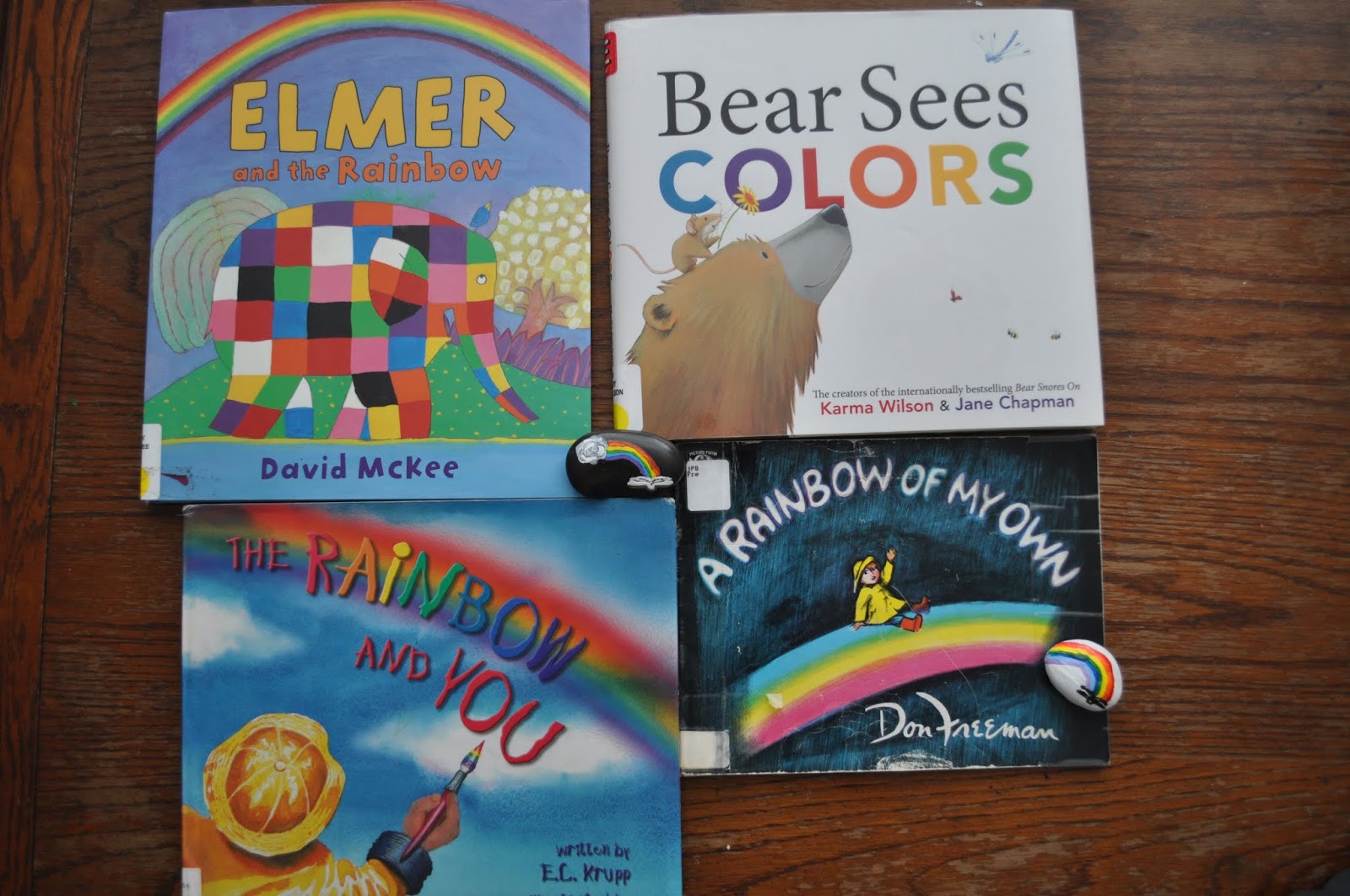
Who doesn't get super excited when they see a rainbow? Kids jump out of their seat, and everyone just takes a minute to admire this art in the sky.  Why not turn your living room, or classroom into a rainbow for an afternoon?  These books, crafts, songs, and activities can help you and your early learners discover all about the colors of the rainbow, plus how to spot one, and enjoy a couple fictional stories that include rainbows.


I'm going to start with what's probably my favorite (so far) non fiction book that has a rainbow in it:

A Rainbow of My Own by Don Freeman

Copyright 1966

This book is from 1966 but it's timeless.  I think every child can relate to the main character. The boy runs outside to try to capture the rainbow just to find it was gone, then as he's wishing for one of his very own, what should come up behind him but a rainbow ready to play! Then when it's time the rainbow leaves and he goes home to find in his room a rainbow on his wall!

This book keeps the sentences simple so it's great for reading to a group, to small children and on their own for independent reading.  The illustrations are fun, colorful, and entertaining. The yellow rain boot, hat and raincoat are classic.

Don Freeman was a creative mind and opens a doorway between reality to imagination back to reality seamlessly.  This doorway in the book, we can pull from it so many opportunities with our own children:
Where and When do you find a rainbow?
If you had a rainbow for your own what would you do together? (This can be used for all ages: Draw a picture. Tell a story. Write a paragraph of what you'd do together.)
Where would a rainbow hide?
How can you make a rainbow of your own?

These are all questions for fiction and non-fiction learning!  I love this book.  This one book out of all you can do a whole rainbow lesson on.  So if you had to pick only one A Rainbow of My Own would be the one, but to enhance your story-time, or lesson add a couple of the other books I have listed here.

Elmer and the Rainbow by David McKee

Elmer has many books (Elmer 12 Book Set Here ) and if your child already knows this patchwork elephant than this is a book to add to your rainbow lesson.  It is another fiction book.

In this adventure Elmer and his friends notice an odd thing in the sky, a colorless rainbow, so Elmer goes off to find the end of the rainbow.  Along the way he asks his jungle friends to help him in his search.  Once the rainbow end is found Elmer goes and gives the rainbow his own colors.

What I love more than anything in this book is this quote:
"Some things you can give and give and not lose any.  Things like happiness or love...."
Brilliant quote about how kindness is free.  Be Kind! 

We all know that there isn't a patchwork elephant, and that's not how rainbows get their colors, but it is a fun imaginative story that can lead to the question of "Well how do rainbows get their color?" (So glad you asked because I have a book to share with you about just that!!)
Elmer has colors on him that aren't in the rainbow.  Point that out!  What colors are on Elmer that aren't in the rainbow?  What colors are in the rainbow?  This would be a great time to share the song In The Rainbow by Pamela Piersyn.  I love this catchy song that isn't annoying, and is educational!  Good bye ROY-G-BIV. Hello "In the Rainbow" Promise you if you play this song the kids will know all 7 colors of the rainbow!  While I sang and listen to this song with the children I assembled a felt board rainbow.  If you want the children to have a fun rainbow toy so they can use all sight, touch, along with hearing check out this stack-able rainbow toy!  It has all 7 colors so they can build their rainbow with the song as well!!


 Two other books that I used for my All the Colors of the Rainbow lesson were Penguins Love Colors by Sarah Aspinall and Bear Sees Colors by Karma Wilson

Both of these books are great for helping children learn their colors.  Penguins Love Colors has rainbows throughout the book and each little penguin has their own color, but the downside to this is that there are only 6 penguins instead of 7.  This is quite common in many early learner rainbow books, they don't mention indigo so when the children are older and they are thrown for a surprise that there are really 7 colors.  Don't let this keep your from using this great story because you can ask them what color is missing?

Bear Loves Colors does not have a rainbow anywhere in the whole book!  So why did I put it in my story time?  Simple, it's a FUN book to read aloud with the children.  The rhymes allows you to let the kids yell out what color Bear is going to see next.  It's reinforcing their colors, and allows them to search each page for things of that color.  Bear sees Blue!  Blue berries...and then you can ask "What do you see that's blue?  You can make a scavenger hunt game out of the book for kids to do next time they are outside to see if they can find each thing bear sees, or something in nature of each color.

In my story times after reading these books that reinforce the color names I did a simple song again using all the colors of the rainbow.  I made little finger puppets for each color out of felt and sang:
"Red color. Red Color, Where are you?" and hold up the red puppet "Here I am. Here I am."  I'll admit it came from this video that my daughter watches.
And after you've gone through all seven colors do "rainbow" or "all the colors" for the last verse.


Now that the children know the colors in the rainbow let's go back and answer that question of "how do rainbows get their color?"  The one non fiction book I used was The Rainbow and You by E.C. Krupp

The Rainbow and You is written for an older audience Amazon suggest 6-12 year old. When I used it I had mostly 5-7 age range in my group and so I didn't read it cover to cover but marked a couple pages and read only a few passages to the group.  I love that E.C. Krupp teaches children how to find a rainbow.  He also shares different legends of Rainbows from Native Americans to Greek Gods.  There's also the science and discovery of rainbows in the book.  It's packed full of information.
Robin Rector Krupp illustrated the book and I love how she portrayed Roy. G. Biv as a person! That image will stay will me now every time I think of ROYGBIV.

Since doing my story time I have found other non fiction books about the rainbow that I need to check out and see if any of those will be better suited for the younger children I typically read to. (I've shared them below)  If you are interested or have read these title please let me know what you thought of them in the comments.


 Craft time!  There are countless rainbow crafts out there!  These are the crafts I've done with my kids both very similar :

1
2
1. Construction Paper assemble a rainbow from cloud to pot if you want to do this for St.Patty's day cut out some gold chips to add to it.

2. We did this one at my daughter's preschool:
*cut a paper plate in half***to  implement the reduce and reuse from environment mindfulness post instead of wasting paper plates reuse some old cereal boxes and cut out a cloud shape
* Tissue Paper Streamer
*cotton balls to make the cloud puffy (or puffy paint)
Assemble the rainbow with the materials

3. For older children you can do some painted rocks:
* smooth rocks, paint, paint markers, and seal.  You can use rocks from your garden, or the dollar store as well as the ones I've shared here.  Before you use the rocks wash and let them dry.  If you use dollar store rocks boil them to remove the wax on them.  The paint and paint pens that I've shared below are amazing! But feel free to experiment and find what works best for you.

I hope you have a wonderful colorful day today and maybe you will even find a rainbow of your own!

The Biggest Love of All

Love. There are candy hearts  and teddy bears, cards and books  filling the shelves. TV commercials  and billboard signs, all...