 As a child's personality develops they will begin to strongly like and dislike many things, from food (since Kindergarten my 9 year old will not eat a tomato) to what they will wear (my 5 year old loves her dresses and will only wear pants when forced to) and all the way down to their favorite color. You may notice that you have a child either at home or in your class that will only color with the purple crayon, or only wears blue. This is a normal part of discovering themselves and becoming independent. For more information about likes and dislikes and check out Scholastic: Why Children Like What They Like.
My youngest has two books that she loves, and we have read many times that address the strong like and dislike and favorite color issue. Both of these books are (mostly) about the color pink. I find it interesting that these are in her most read pile of books since pink is not her favorite color, but she loves these books. We have read them so much she can re-tell them to herself which makes her extremely proud that she can "read" the book.
Pinkalicious
Written by Victoria and Elizabeth Kann
Illustrated by Victoria Kann
We got this book as a prize for finishing 1,000 Books Before Kindergarten last fall. The book is a fun one to read together and we have read it a least 20 times in the past year.

The story is about a little girl who makes pink cupcakes with her mom and eats so many of them that she turns pink. While the girl thinks that being pink is wonderful and dresses in a pink dress her mom is concerned and rushes her to a doctor who tells her to avoid any more pink food. On the way home "Pinkerbelle" as she calls herself discovers the downside to being bright pink from head to toe is that all the birds and insects think she's a flower. Does she follow the doctor's orders? Or does she eat another pink cupcake?
I love the story, but the illustrations irk me. Victoria Kann has done a great job filling the page with color, mostly pink, but the disproportionate illustrations bother me. Example of the disproportionate drawings is: the flowers at the park are as tall as or taller than the girl. I think this is just my personal opinion and that I'm missing the whimsical effect and focus too much on reality. Regardless of the proportion of the items in the images, they capture the child's attention, help in telling the story and give you more talking points. Example when in the book it say "....climbed onto a chair, and reached on my tippy toes to the top...[to get a cupcake]" the illustration there shows more of a story she didn't just get on a chair she piled stuff on top of the table to reach. So you can use this to ask "Is she being safe?" "What all did she use?" "What do you think would happen if you tried that?" Maybe you could even get doll house items or blocks and try to reconstruct that balancing act.
I think what makes this book so fun, besides the child turning pink, is all the unique word play around pink. I know that Victoria and Elizabeth have expanded on Pinkalicious to include many other colors as well so if you're interested in more like this one check out these:
A fun activity to go along with this book is to make pink cupcakes!
Polly's Pink Pajamas
Written by Vivian French
Illustrated by Sue Heap
As the title gives away Polly loves her pink pajamas, but when she gets an invitation to a birthday party she is worried that she needs different clothing so she goes to each of her friends asking to borrow an article of clothing. Remember this is a children's story so don't over think why she doesn't have a dress, a sweater, socks or shoes of her own. Each friend has their own color, which you can clearly see in the illustrations. So she borrows something from each friend, puts it on and then looks in the mirror to see that not only do the colors and different patterns clash but that some articles are too small while others are too big. So Polly cries that she can't go to the party. (This part annoyed me,l that she just sat and cried instead of figuring something else out, but it all works out.) Her friend that invited her to the party calls to find out why she's not there and when she tells him he informs her that it's a Pajama Party and everyone who lent Polly clothing is there.
There is a lot of pink in the illustrations again, but for each friend Polly visits their page is full of their favorite color. Mia's page is all red. Her clothing is red, her dog is red, the walls, carpet, everything. The illustrations aren't done in a pleasing way for adults, it's not neat and tidy and professional in the way many books are, but rather very simple and child like art. As much as I look at the artwork and think Blues Clues style or art and don't want to like it, the more I look at it and think of all the children who are looking at this saying "I can draw something like that" and that it's inspiring children to do art that they will try to illustrate their own book because it's work that's relatable to them.
I love the large text in this book, it helps with children looking at each word to see what it is. The child is also learning colors, and patterns. The retelling of each article of clothing helps with memory and reading skills.
Mom's you can use this book before Spring cleaning when you tackle that pile of laundry and have to get your children to try on their clothes to see what fits and what is too small or too big.
Some fun activities you can do along with this is to talk about what would match with each item. cut out different paper clothing articles and have them pair them up. Would you wear a green sweater with a red polka-dot dress, or a white dress? Many children love the magnetic dolls that you can dress up and mix and match outfits.
You can have your own pajama party and plan it out.
I hope your day is full of color!

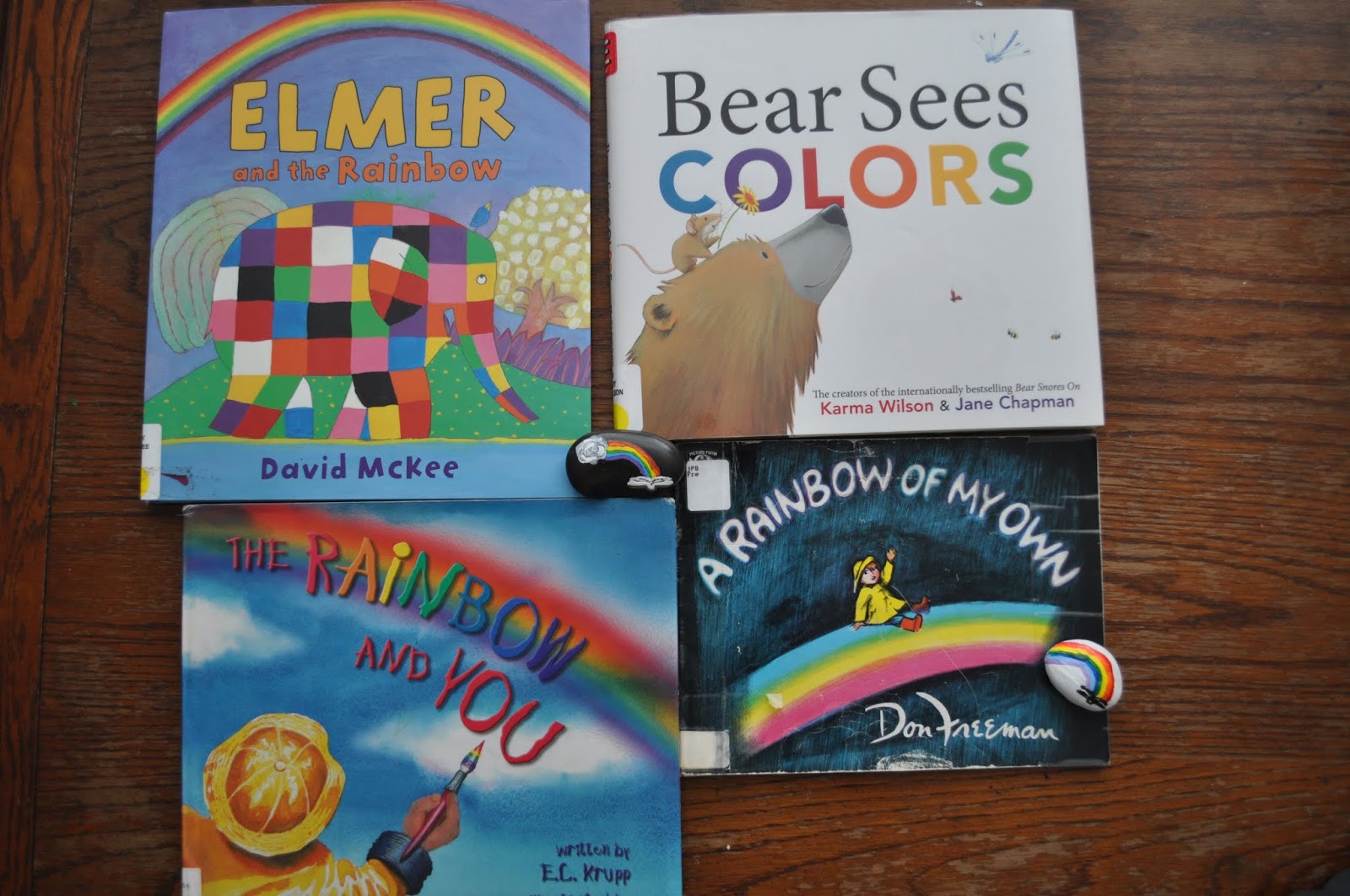
 ) and if your child already knows this patchwork elephant than this is a book to add to your rainbow lesson. It is another fiction book.
 Both of these books are great for helping children learn their colors. Penguins Love Colors has rainbows throughout the book and each little penguin has their own color, but the downside to this is that there are only 6 penguins instead of 7. This is quite common in many early learner rainbow books, they don't mention indigo so when the children are older and they are thrown for a surprise that there are really 7 colors. Don't let this keep your from using this great story because you can ask them what color is missing?


 assemble a rainbow from cloud to pot if you want to do this for St.Patty's day cut out some gold chips to add to it.


